Everyone is building AI products right now. Most of them will fail in the “Large Customers / Enterprises” B2B market – not because the technology is bad, but because the builders do not understand what enterprise clients actually need before they say yes.
I gave a talk recently on exactly this. Here is everything in one place, written for the founders who are building AI tools for professional services – the space where the real money is.
The $20 Trillion Opportunity Most AI Builders Ignore
Let me start with the number that should get your attention: $20 trillion.
That is the estimated size of the professional services industry globally – law firms, accounting and tax practices, consulting and advisory firms, insurance companies, and wealth management. It is one of the largest, most entrenched, and historically least disrupted industries in the world.
AI is coming for all of it.
This is not a prediction. It is already happening. Firms are actively looking for AI tools that can help them cut costs, serve clients faster, and reduce the margin for human error. The question is not whether they will adopt AI. The question is whether they will adopt your product – or someone else’s.
The AI Imperative: Leverage It or Fall Behind
Here is what firm leaders are discussing right now in every major accounting, legal, and advisory conference:
“Leverage AI or die.”
That sounds dramatic. It is not.
Firms that adopt AI effectively will be able to:
- Cut costs significantly across back-office and front-office operations
- Serve clients faster and better – reducing turnaround times from days to hours
- Eliminate human error and complacency in routine, high-volume tasks
- Improve accuracy – reviewing, verifying, and validating work that humans often rush through
- Clarify gray areas – surfacing options, assumptions, pros and cons that advisors previously had to work out manually – and only the most experienced ones could do
Firms that do not adapt will find themselves priced out of the market by competitors who moved faster. The window for “we’ll get to AI eventually” is closing quickly.
This is the environment your B2B AI product is entering. Your clients are not experimenting. They are making strategic decisions about their future. That changes everything about how you should build and sell.
Where We Are in AI Right Now (And Why It Matters for Builders)
Before you build, you need to understand where we actually are in AI development. There are four stages:
- Stage 1 – Artificial Narrow Intelligence (ANI): AI that is highly capable at specific, defined tasks. We just crossed stage 1 in mid-2025s. Tools like large language models, image recognition, and specialized assistants all fall here. ANI is powerful, but it operates within boundaries.
- Stage 2 – Artificial General Intelligence (AGI): AI that can perform any intellectual task a human can. We are about to hit this stage, though the timeline and the expectation are debated.
- Stage 3 – Artificial Superintelligence (ASI): AI that surpasses human intelligence across all domains.
- Stage 4 – Recursive Self-Improving AI / Autonomous AI Ecosystems: AI that improves itself, potentially at an accelerating pace.
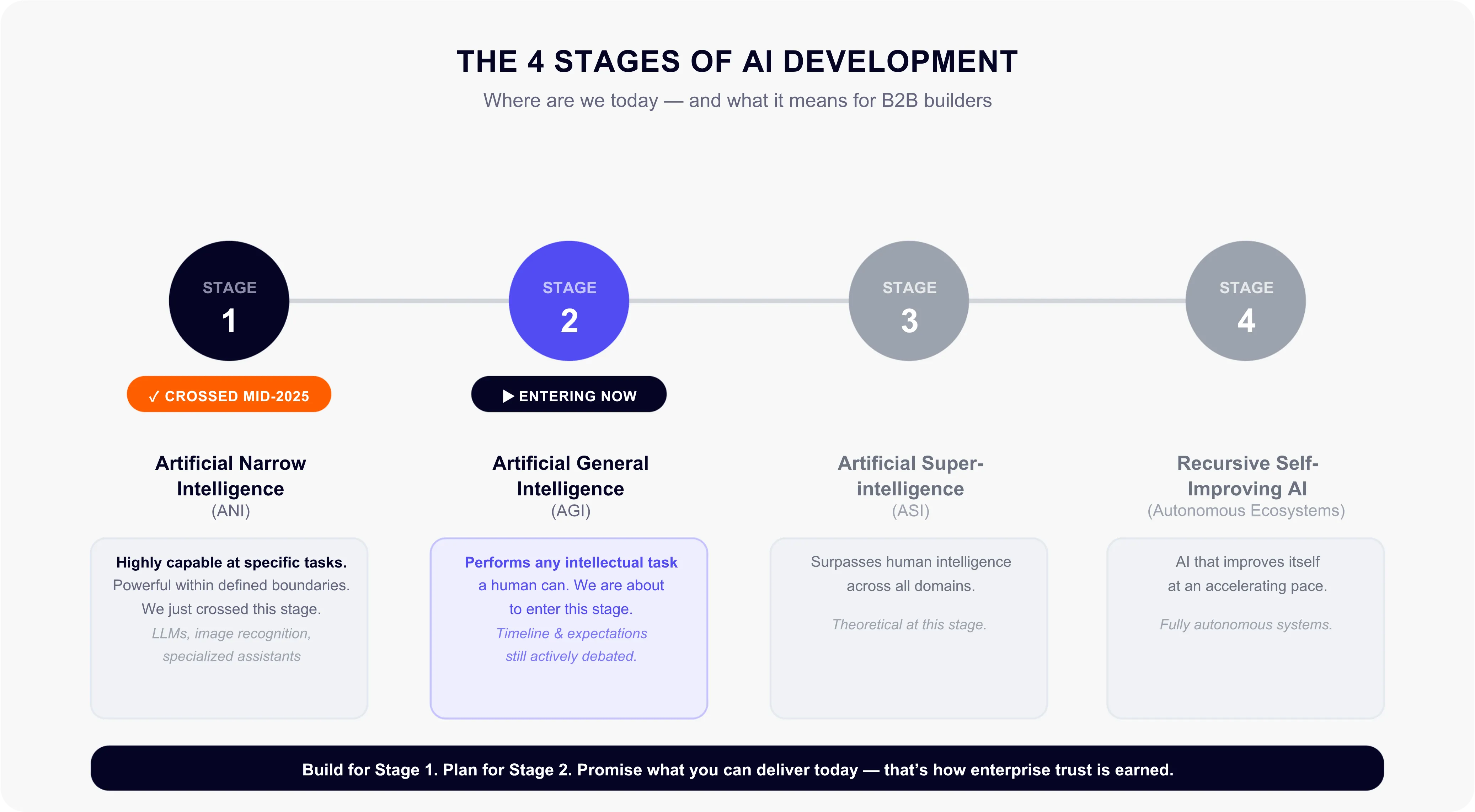
We are about to enter Stage 2. That is important for builders to internalize. Your product will be built on narrow AI capabilities, and your enterprise clients know this. They are not expecting magic. They are expecting reliable, accurate, compliant automation of specific tasks they already do every day.
If you build for Stage 1 and market for Stage 1, promise what you can actually deliver today – you would be a credible seller. Lay out plans for Stage 2. That is how you build trust in enterprise.
Know Your Target Client Before You Write a Single Line of Code
This is where most B2B AI products go wrong. The builder assumes their product is for “everyone in the industry.” That is a fatal mistake.
The first question you need to answer honestly is: Who is your target client?
In professional services, there are two very different buyer profiles:
Big Firms and Enterprises are your primary target if you want scale, contract size, and credibility. They have procurement processes, security review teams, and long sales cycles. Be ready for this. They also have the budget to pay serious money for serious tools – including a paid Proof of Concept (POC). If your product lands one enterprise client, it validates your entire category.
Small and Mid-Size Firms move faster, have shorter sales cycles, and are often more willing to try new tools. But they have smaller budgets and less standardized processes.
The product you build for one is not the product you build for the other. Enterprise clients have in-house IT teams, compliance officers, and their own security frameworks. They will evaluate your product against internal standards before a single employee touches it. SMB clients often need you to be their IT team.
Decide which one you are building for first. Everything – from your features to your pricing to your onboarding to your security documentation – flows from that decision.
What Enterprise Buyers Actually Want From Your Product
Once you know you are targeting enterprise or large professional services firms, the product requirements become very specific.
Easy-to-Use Interface
Enterprise buyers have to roll your product out across teams of 50, 100, or 500 people. If the interface requires extensive training, they will not buy it. They are not looking for the most technically impressive product. They are looking for the one their team will actually use.
Keep the UI clean. Keep workflows intuitive. Reduce friction at every step. The best enterprise AI tools are the ones that feel obvious to a first-time user.
Implementation Support
Enterprise clients do not self-onboard. They expect you to have a process. When they sign a contract, they want to know exactly what happens next: who will manage the implementation, how long it takes, what is required from their team, and what success looks like at the end.
If you do not have a structured implementation process, you are not enterprise-ready.
Automatic Updates and SLA Guarantees
Enterprise firms operate in regulated environments. They cannot have your product go down during tax season or in the middle of an audit. They need to know that updates happen automatically (so their team is always on the latest, most compliant version), and they need a Service Level Agreement that defines your uptime commitments, response times for issues, and escalation paths.
SLA is not a nice-to-have. For enterprise, it is a purchase requirement.
The Caveat Nobody Tells You About
Here is where most AI builders get blindsided.
You have built a great product. The demo goes well. The enterprise prospect loves it. Then their compliance team gets involved – and everything slows down or stops.
Why? Because professional services firms operate under strict regulatory and ethical obligations that most AI builders do not fully understand.
Take accounting firms as one example. The IRS mandates that CPAs ensure data security and protect Personally Identifiable Information (PII). This is not optional. It is a professional and legal requirement. If your product handles client financial data – which any accounting AI tool will – it must meet specific data protection standards before any compliant firm can use it.
The same is true across professional services. Law firms have attorney-client privilege requirements. Insurance firms have state regulatory requirements. Consulting firms serving enterprise clients inherit their clients’ compliance obligations.
Your product will be evaluated against these standards. If you have not built with compliance in mind from day one, you will fail that evaluation.
The good news: this is also your competitive moat. Most AI startups are not doing this work. If you do, you win deals that your competitors cannot even enter.
The Questions Your B2B Clients Will Ask Before They Sign
Here is the example of a checklist that enterprise and professional services clients run through before they approve any AI tool. I have seen this play out with my own firm’s clients and with the firms I advise. Know these questions before your first enterprise conversation.
On security certifications:
- What security certifications do you hold? (SOC 2, ISO 27001, CASA)
- Can you provide documentation?
On data handling:
- Do you segregate and isolate customer data?
- Is all data encrypted at rest and in transit? Which methods are used?
- What are your policies for employee access to customer data?
- How long is personal data stored? Is it ever shared or sold?
On incident response:
- What is your process for incident response and breach notification?
- How quickly are affected clients notified?
On user consent and audit:
- How do you obtain and document user consent?
- Can we access audit logs?
- How do you handle model updates that could affect outputs?
On third-party risk:
- Who are your third-party sub-processors?
- What are their security certifications?
- Can we sign a Data Processing Agreement (DPA)?
- Does your DPA include GDPR/CCPA-compliant clauses?
If you cannot answer every one of these questions clearly and confidently, you are not ready for enterprise. Build the answers before you need them.
Leave No Doubts: The Security Stack That Closes Enterprise Deals
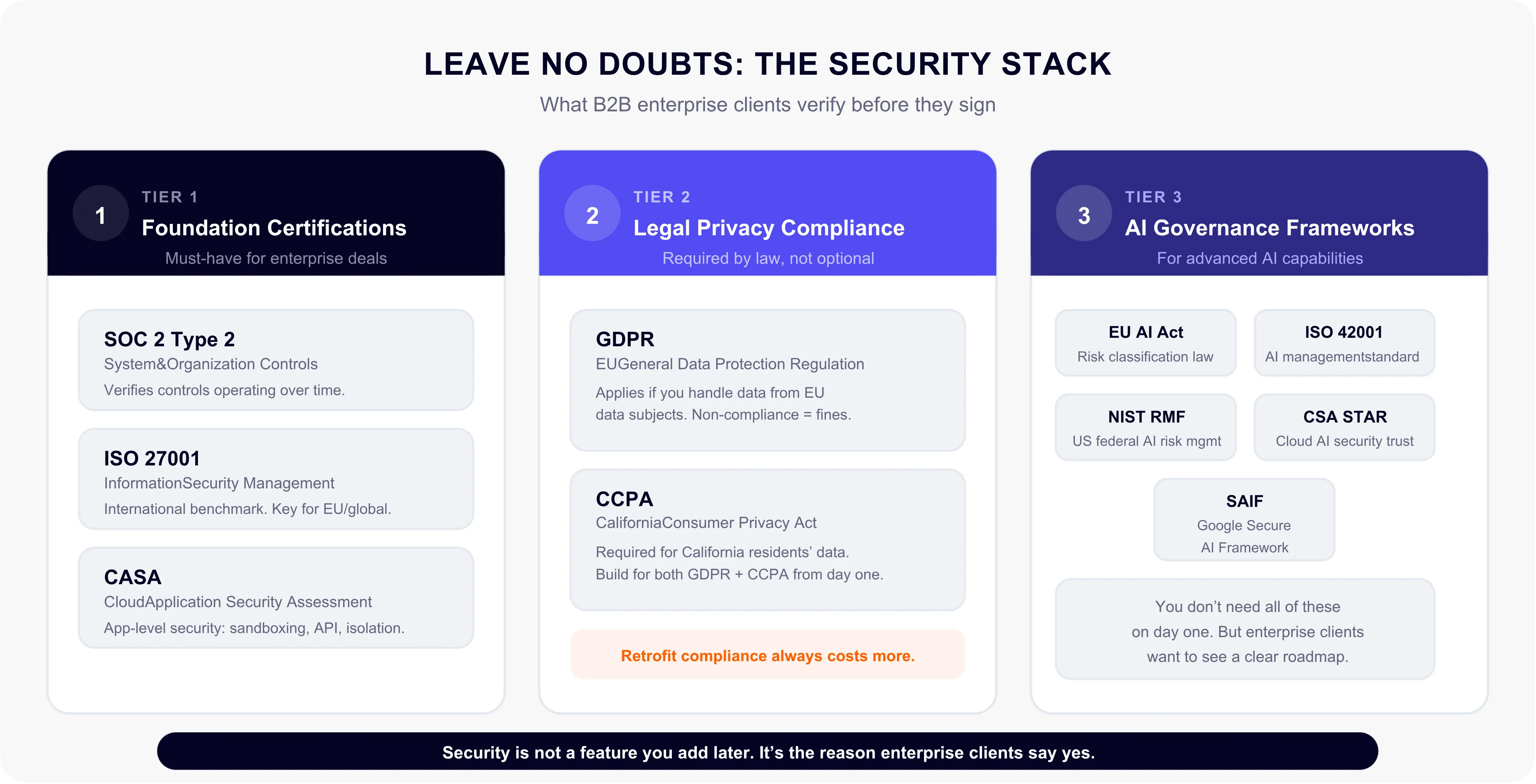
Enterprise trust is not built on a pitch deck. It is built on documentation, certifications, and verified processes. Here is what the security stack looks like for an AI product that can close enterprise deals in professional services.
Tier 1: Technical and Organizational Certifications
SOC 2 Type 2 is the gold standard for B2B SaaS in the US market. It covers five Trust Service Criteria: Security, Availability, Processing Integrity, Confidentiality, and Privacy. A Type 2 report verifies that your controls have been operating effectively over a period of time – not just that they exist on paper. For enterprise clients that need strong guarantees backed by documented audits, SOC 2 Type 2 is often a prerequisite before any contract is signed.
CASA (Cloud Application Security Assessment) is rigorous for technical app-level security – sandboxing, isolation, API usage. It is particularly relevant if your product integrates deeply with third-party platforms. CASA complements SOC 2 rather than replacing it.
ISO 27001 is the international standard for information security management. If you are selling into European markets or to firms with global operations, ISO 27001 certification signals that your security practices meet internationally recognized benchmarks.
Tier 2: Legal Privacy Compliance
GDPR (if you handle data from EU data subjects) and CCPA (if you handle data from California residents) are legal requirements, not optional features. Build your data handling practices to comply with both from day one. The cost of retrofitting compliance after a breach or regulatory inquiry is always higher than building it correctly from the start.
Tier 3: AI-Specific Governance Frameworks (For Advanced AI)
If your product uses more advanced AI capabilities – agentic systems, automated decision-making, or high-risk use cases – you will increasingly need to demonstrate compliance with emerging AI governance frameworks:
- EU AI Act: The first comprehensive AI law, classifying AI systems by risk level and setting obligations accordingly
- ISO 42001: The international standard for AI management systems
- NIST AI Risk Management Framework (RMF): The US federal framework for managing AI risks
- CSA STAR: Security trust for cloud-based AI services
- SAIF (Google’s Secure AI Framework): Increasingly referenced in enterprise AI conversations
You do not need all of these on day one. But you need a roadmap that shows enterprise clients you take AI governance seriously and are building toward it.
The AICPA-Recommended Approach for Professional Services AI
For those specifically targeting accounting and tax practices – which is a significant and underserved market – the American Institute of Certified Public Accountants (AICPA) has shared a recommendation in the 2025 AICPA conference on AI tool adoption.
Their recommendation is notable: Microsoft Azure and Co-Pilot, operating within a closed network.
Why does this matter for builders? Because it tells you two things:
First, enterprise-grade infrastructure is not negotiable. If your product is running on infrastructure that cannot meet the security and compliance standards of a Microsoft Azure deployment, you have a fundamental architecture problem to solve before you can sell to compliant firms.
Second, the concept of a closed network is becoming standard expectation in enterprise AI. A closed network means your AI operates only on data within a firm’s-controlled environment – not training on client data, not sending data to shared models, not creating cross-contamination risks between clients. If your product cannot offer this architecture, you may lose deals to products that can.
Understanding the AICPA’s position matters even if you are not selling to accountants. Law firms, insurance companies, and advisory firms will follow similar guidance from their own professional bodies. The pattern is the same: enterprise-grade cloud infrastructure, closed network or private deployment options, and documented compliance.
Build for this from the start. Retrofitting it is expensive. Starting with it is a competitive advantage.
Final Thoughts
Building a B2B AI product is not just a technical problem. It is a trust problem. Enterprise and professional services clients have regulatory obligations, fiduciary duties, and client relationships that they cannot put at risk for a promising demo.
The builders who win in this market are the ones who understand compliance as a feature – not a burden. They build security certifications into their roadmap. They answer the hard questions before they are asked. They make it easy for a compliance team to say yes.
The $20 trillion opportunity is real. But it belongs to the builders who do the work that most others skip.
Running your US startup with the right partner?
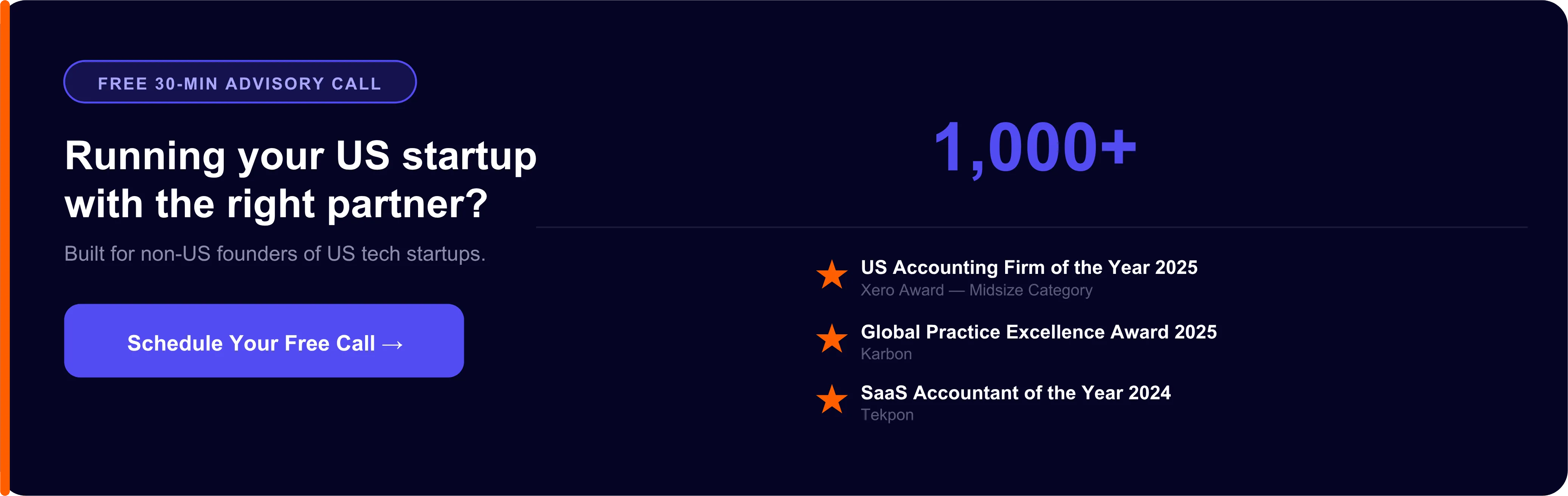
At Tukel Accounting, we work exclusively with non-US founders who are operating US tech companies – and we have seen firsthand what separates the founders who build confidently from the ones who spend years fixing what they should have done right from the start.
If you are a non-US founder navigating US accounting, tax, or financial strategy, book a free 30-minute advisory call with me – just real answers to your real questions.