AI agents are having a moment. But if implemented without foundations, they don’t scale.
What you need first is a system built on workflows, which often means starting with the basics before finding your way to AI agents.
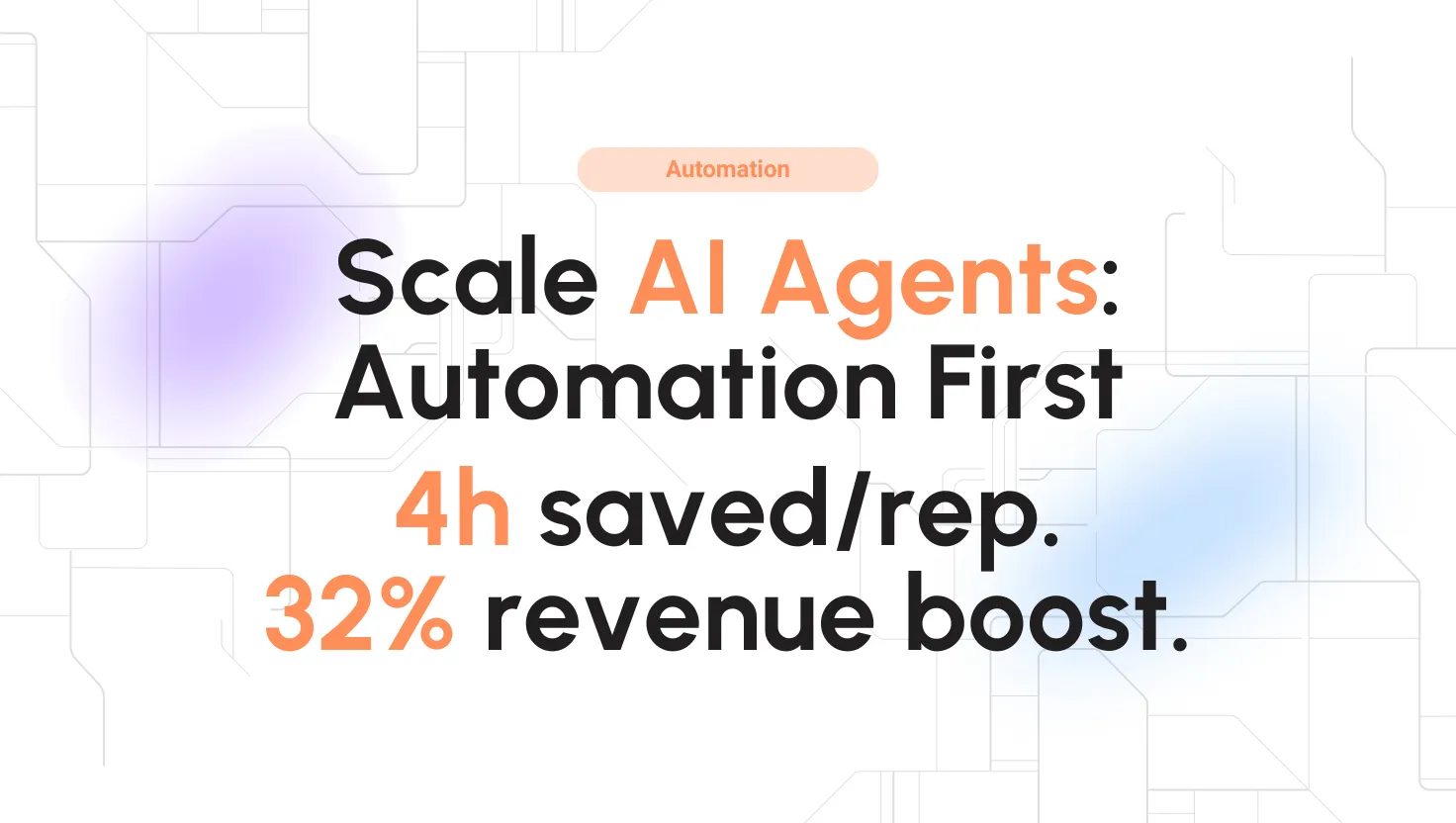
This article shows that approach in practice with Make’s Post-Call Hero, a Sales Ops example that unlocked 4 hours per rep per week and contributed to a 32% increase in sales revenue.
Post-Call Hero: What AI scale looks like in practice
Sales workflows are a great area to tackle for AI agents and automation.. They run at high volume, they’re measurable, and they sit close to revenue.
For example, in sales, account executives want to spend time with customers, not with post-call clean-up. Yet after every conversation, the same admin work shows up: notes, CRM updates, follow-ups, internal alignment. As a sales rep, you end up with the reality – either keep the selling time and sacrifice CRM hygiene or fall behind on the ambitious quota because of admin work.
At Make, we built Post-Call Hero to remove that friction. It’s an AI agent designed as part of a broader system that analyses sales-call transcripts and orchestrates follow-up actions. The point isn’t “a better summary” after a call or structured meeting notes. It’s a workflow where an automated transcript turns into action.
In practice, Post-Call Hero can:
- generate or update internal notes
- draft follow-up emails
- create Slack channels to align stakeholders
- suggest CRM updates, with human-in-the-loop approval
When a customer meeting ends, the account manager receives structured notes, a drafted follow-up in Slack, and suggested CRM updates they can approve or edit. If a technical question comes up, a Slack channel is created to bring in the right solution engineer.
The impact was immediate:
- 4 hours per rep per week of selling time
- 32% increase in sales revenue
That kind of outcome is hard to get when AI is bolted onto an existing process. It happens when the workflow is redesigned end-to-end, with clear inputs, constraints, and measurement.
The ripple effect of one well-designed workflow
This is the part that many teams underestimate. Once transcripts and call outputs become structured inputs, downstream loops stop being “nice to have” and start being easy to run consistently.
For Post-Call Hero, that meant two compounding follow-ons:
- a Sales coaching agent (immediate feedback after each sales call, collecting team improvement points)
- a Product feedback loop (identifying product gaps and linking signal to the roadmap)
Sales calls are one of the richest sources of product insight, but the signal often gets lost in human memory and scattered notes. A structured loop makes patterns visible: recurring friction, repeated requests, common objections, and the moments where value isn’t landing. That’s how one workflow starts compounding.
Scalable AI rests in a full automation spectrum
To scale AI meaningfully, it helps to stop thinking in tools and start thinking in the spectrum of work.
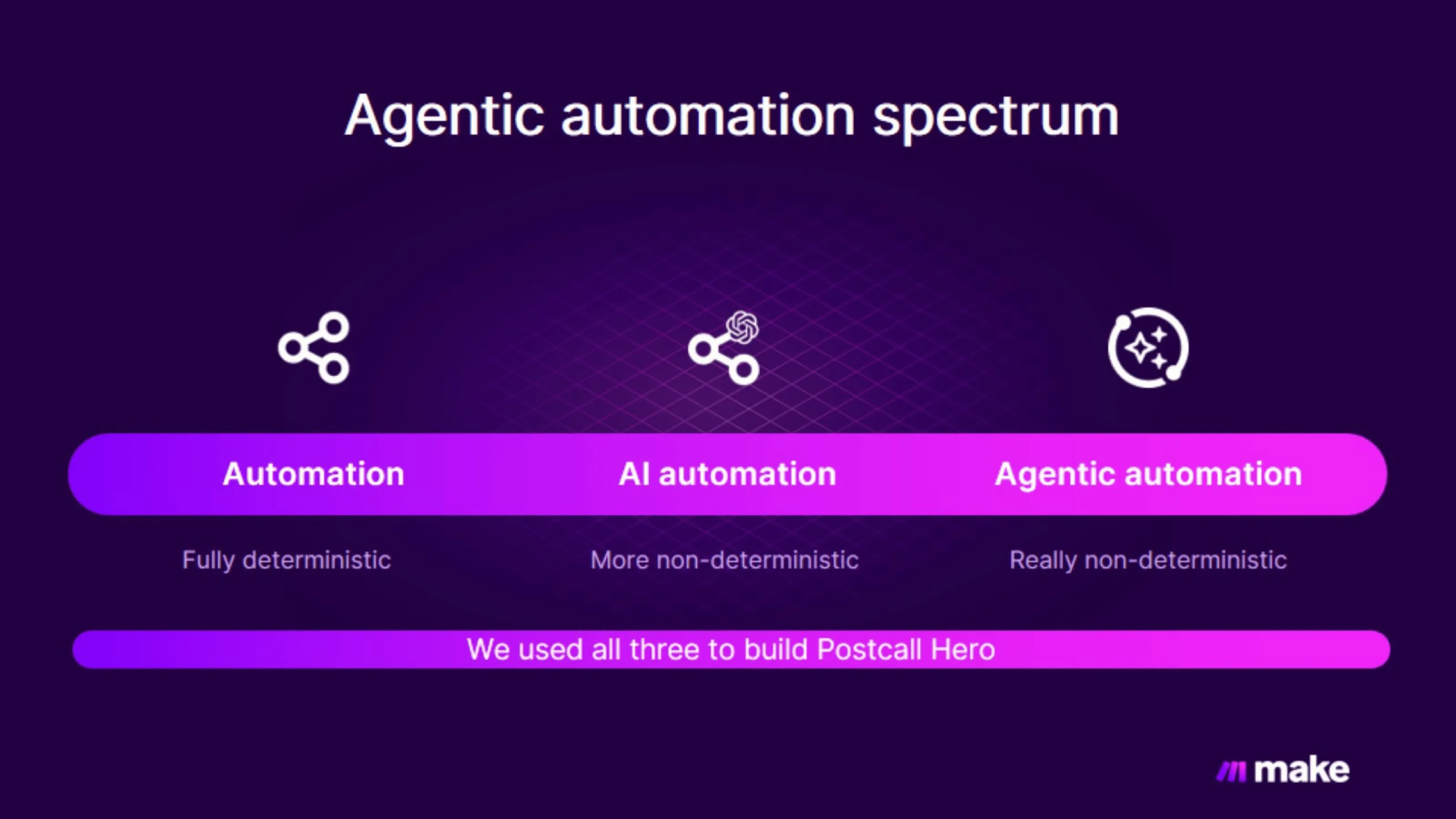
- Automation is fully deterministic. Classic workflows, clear rules, predictable outputs. Great for the parts of a process that should be boring.
- AI automation is more non-deterministic. AI inside workflows to classify, summarise, extract, rewrite, route, or evaluate. Still orchestrated by a workflow. Still measurable. Still guided by constraints.
- Agentic automation is really non-deterministic. Agents that can reason, choose tools, and take action across steps. Powerful, but harder to predict. They require stronger guardrails and better foundations.
In practice, the question isn’t which category you prefer. It’s which parts of your process must be predictable, and which parts benefit from intelligence.
This is also where a common myth shows up: “agents are the main component.” They are not. In Post-Call Hero, agents were not the bulk of the system. They were a layer.
Looking at what actually made the workflow work, the breakdown may be a surprise:
- 7 processes were classic automation
- 3 processes were AI automation
- 1 process was agentic automation
This is why agent-first strategies often stall. If agents sit on top of messy foundations, they become a patch for unclear workflows and unreliable inputs. And patches do not scale.
Why agent demos break in production, and how to fix it
This is where many “agent demos” fall apart. An agent is only as good as the context it is given, the tools it can use, and the guardrails around decisions.
If you can’t constrain the inputs and decisions, you can’t predict the outcome. With Post-Call Hero, reliability came from clear boundaries. The workflow runs on four context files and gives the agent five tools to choose from for follow-up orchestration. Instead of adding “more intelligence”, we reduced ambiguity. That’s the difference between a demo and a workflow you can trust in production.
Constraints make an individual agent dependable. Traditional automation makes the organisation dependable at scale.
At Make, the internal numbers make the foundation visible:
- ~2500 automation processes
- ~300 AI automation processes
- ~150 AI agent processes
Traditional automation is still the core operating system. It gives reliability, governance, observability, repeatability, and cost control. It is what allows scale across teams without chaos.
How to apply this tomorrow
Here’s the practical part, distilled into three principles that hold up in production.
- Don’t shop for AI tools. Scale rarely comes from another tool in the stack. It comes from end-to-end workflows that connect systems, data, and people, and can be rolled out across teams without turning into a patchwork.
- Leverage the full spectrum. Agents, AI automation, and traditional workflows work best combined. Start by making the foundation predictable. Use AI where it adds leverage (extraction, classification, summarisation, routing). Introduce agents only when orchestration and tool choice truly pays off.
- Build up towards agents. Agents amplify what is already there. That is the advantage and the risk. If the workflow is unclear, the data is messy, or ownership is missing, the agent will amplify the mess. But when the foundation is solid, agents become a multiplier, not a patch.
Final thought
Agents are exciting, and they are the technology of the future.
At Make, we’re already witnessing the impact they can bring us across many areas of the business – like in this example of sales ops.
But if our Postcall Hero taught us anything, it’s that for agents to have impact, you need to build the foundation across the spectrum first.