SOC 2 compliance cost ranges from $20,000 to $150,000+ for most SaaS companies, depending on company size, audit type, and whether you use manual processes or compliance automation software. ISO 27001 certification cost follows a similar range, with external audit fees between $10,000 and $50,000 and total first-year costs reaching $40,000 to $100,000 without automation.
For growing SaaS companies, understanding the real cost of compliance is critical for budgeting and for making the business case to leadership. The numbers vary widely because compliance costs are driven by multiple factors – company size, framework complexity, tooling choices, and whether you build in-house expertise or rely on consultants.
This guide breaks down the actual costs for SOC 2, ISO 27001, PCI DSS, and HIPAA compliance – including audit fees, preparation costs, and how compliance automation software can reduce total spend by 60-80%.
SOC 2 compliance cost: full breakdown
SOC 2 is the most common compliance framework for B2B SaaS companies selling to enterprise customers in the US. The SOC 2 compliance cost breaks down into three categories: external audit fees, preparation costs, and ongoing maintenance.
SOC 2 audit cost: external auditor fees
The SOC 2 audit cost – what you pay the CPA firm to conduct the actual examination – depends on the audit type and your company’s complexity.
| SOC 2 Audit Type | Typical Cost Range | What It Covers |
|---|---|---|
| Type I (point-in-time) | $7,500 - $25,000 | Evaluates control design at a single point in time. Faster but less trusted by enterprise buyers. |
| Type II (observation period) | $15,000 - $60,000 | Evaluates control design AND operating effectiveness over 6-12 months. Required by most enterprise customers. |
| Type II renewal (annual) | $12,000 - $45,000 | Annual re-examination. Usually cheaper than the first Type II since the auditor knows your environment. |
The range is wide because SOC 2 audit cost depends on factors like the number of trust service criteria in scope (security only vs. security + availability + confidentiality), the size of your engineering team, the complexity of your infrastructure, and how organized your evidence is when the auditor arrives.
SOC 2 preparation cost: getting audit-ready
The preparation phase is where costs vary the most – and where companies tend to underestimate.
| Cost Category | Manual / Consultant Approach | With Compliance Automation |
|---|---|---|
| Gap assessment and readiness review | $5,000 - $25,000 (consultant) | Included in platform (automated gap analysis) |
| Policy and procedure documentation | $5,000 - $15,000 (consultant or internal) | Pre-built templates included in platform |
| Control implementation and testing | $10,000 - $40,000 (internal staff time) | $3,000 - $8,000 (platform + reduced staff time) |
| Evidence collection and organization | $10,000 - $30,000 (internal staff time) | Automated - minimal staff time |
| Security tooling (if not already in place) | $5,000 - $20,000/year | $5,000 - $20,000/year (same - platform does not replace security tools) |
| Compliance platform subscription | N/A | $3,000 - $25,000/year |
Total first-year SOC 2 cost: $50,000 – $150,000+ manually, or $20,000 – $60,000 with compliance automation.
ISO 27001 certification cost: full breakdown
ISO 27001 certification cost follows a different structure because the certification process involves two stages, a three-year cycle, and annual surveillance audits.
Stage 1 + Stage 2: certification audit fees
| ISO 27001 Audit Phase | Typical Cost Range | What Happens |
|---|---|---|
| Stage 1 (documentation review) | $3,000 - $10,000 | Auditor reviews your ISMS documentation, policies, and risk assessment. Identifies gaps before Stage 2. |
| Stage 2 (on-site/remote assessment) | $8,000 - $40,000 | Full audit of control implementation and operating effectiveness. Certification decision made here. |
| Annual surveillance audit | $5,000 - $20,000 | Annual check to verify continued compliance. Required in years 2 and 3 of the cycle. |
| Recertification (year 3) | $8,000 - $35,000 | Full re-assessment at the end of the 3-year cycle. |
ISO 27001 preparation cost: building the ISMS
The preparation costs for ISO 27001 tend to be higher than SOC 2 because the standard requires a complete Information Security Management System (ISMS) with formal risk assessment, risk treatment plan, statement of applicability, and ongoing measurement processes.
- ISMS design and implementation: Building the management system from scratch requires defining scope, conducting a formal risk assessment, selecting controls from Annex A, and documenting the entire system. Consultant-led implementations typically cost $15,000 – $40,000. With a platform like Copla, pre-built workflows and control mappings reduce this to 4-8 weeks of internal effort.
- Risk assessment and treatment plan: ISO 27001 requires a documented risk assessment methodology and a risk treatment plan that maps identified risks to specific controls. This is often outsourced to consultants at $5,000 – $15,000, or handled internally with platform guidance.
- Policy documentation: The standard requires a comprehensive set of information security policies. Building these from scratch takes 40-80 hours of internal time, or $5,000 – $12,000 in consultant fees. Compliance automation platforms provide policy templates that reduce this to review and customization.
- Internal audit: ISO 27001 requires at least one internal audit before the certification audit. Budget $3,000 – $8,000 for an external internal auditor, or conduct it in-house if you have qualified staff.
- Training and awareness: All employees must receive information security awareness training. Budget $1,000 – $5,000 for a training platform or program.
Total first-year ISO 27001 certification cost: $40,000 – $100,000+ manually, or $15,000 – $45,000 with compliance automation.
For a detailed look at Copla’s framework-specific pricing (starting at EUR 2,999/year for ISO 27001), see our Copla pricing review.
PCI DSS and HIPAA compliance cost
For SaaS companies that handle payment data or health information, PCI DSS and HIPAA compliance add additional cost layers.
PCI compliance cost
PCI DSS compliance cost depends heavily on your merchant level and how you process payments. Companies that use tokenized payment processors (like Stripe or Braintree) have significantly lower scope than those handling raw cardholder data.
| PCI DSS Component | Typical Cost |
|---|---|
| Self-Assessment Questionnaire (SAQ) | $5,000 - $15,000 (internal effort) |
| Qualified Security Assessor (QSA) audit | $15,000 - $75,000 |
| Quarterly ASV scans | $1,000 - $5,000/year |
| Penetration testing | $5,000 - $30,000/year |
| Remediation and infrastructure changes | $10,000 - $100,000+ (highly variable) |
Total PCI compliance cost: $15,000 – $200,000+ depending on scope and current security posture.
HIPAA compliance cost
HIPAA compliance cost for SaaS companies (as business associates) typically includes risk analysis ($5,000 – $20,000), policy development ($5,000 – $15,000), employee training ($1,000 – $5,000/year), and technical safeguard implementation ($10,000 – $50,000+).
HIPAA does not have a formal certification process, but third-party assessments are common and cost $10,000 – $50,000. Total first-year HIPAA compliance cost for a mid-size SaaS company ranges from $30,000 to $100,000.
Compliance cost comparison: all frameworks
Here is a side-by-side comparison of compliance costs across the major frameworks, for a typical mid-size SaaS company (50-200 employees):
| Framework | External Audit Fee | First-Year Total (Manual) | First-Year Total (Automated) | Ongoing Annual Cost |
|---|---|---|---|---|
| SOC 2 Type II | $15,000 - $60,000 | $50,000 - $150,000 | $20,000 - $60,000 | $25,000 - $70,000 |
| ISO 27001 | $10,000 - $50,000 | $40,000 - $100,000 | $15,000 - $45,000 | $15,000 - $40,000 |
| PCI DSS | $15,000 - $75,000 | $30,000 - $200,000 | $20,000 - $80,000 | $15,000 - $50,000 |
| HIPAA | $10,000 - $50,000 | $30,000 - $100,000 | $15,000 - $50,000 | $10,000 - $30,000 |
| DORA | Regulatory oversight | $50,000 - $200,000 | $20,000 - $80,000 | $20,000 - $60,000 |
Multi-framework savings
What drives compliance costs up (and how to reduce them)
The cost ranges above are wide because several factors can push your compliance spend significantly higher – or lower. Understanding these drivers helps you budget accurately and avoid the most expensive mistakes.
Cost driver 1: manual evidence collection
The single biggest cost driver in any compliance program is manual evidence collection. When teams gather evidence through screenshots, spreadsheet exports, and email chains, the process consumes hundreds of staff hours per audit cycle.
Compliance automation software eliminates most of this work by connecting directly to cloud infrastructure, identity providers, HR systems, and DevOps tools to collect evidence continuously. This alone typically reduces total compliance cost by 40-60%.
Cost driver 2: late starts and reactive approaches
Companies that begin compliance preparation 3-6 months before a customer deadline or audit date pay a premium. Rush implementations require more consultant hours, overtime from internal staff, and often result in temporary fixes that need to be rebuilt later.
Starting early – ideally 6-12 months before your first audit – allows you to spread the work across normal operations and avoid premium rates.
Cost driver 3: over-reliance on consultants
Compliance consulting fees range from $150 to $400 per hour. A full consultant-led SOC 2 implementation can easily exceed $80,000 in consulting fees alone. While consultants provide valuable expertise, using them for tasks that can be automated (evidence collection, control monitoring, policy templates) is an expensive choice.
The most cost-effective approach combines a compliance automation platform with targeted consulting for complex decisions like risk assessment methodology and control design.
Cost driver 4: disorganized infrastructure
Companies with sprawling, undocumented cloud environments, inconsistent access controls, and no centralized identity management face higher implementation costs because there is more foundational work to do before compliance controls can be applied.
Investing in infrastructure hygiene (centralized IAM, documented architecture, consistent configuration management) before starting compliance reduces both the effort and the cost.
The cost of non-compliance
While compliance costs can feel significant, the cost of non-compliance is almost always higher. Here is what companies face when they skip or fail compliance:
- Regulatory fines: GDPR violations can reach 4% of annual global revenue or EUR 20 million, whichever is higher. HIPAA violations carry penalties up to $1.5 million per violation category per year. PCI DSS non-compliance can result in fines of $5,000 to $100,000 per month from card brands.
- Lost enterprise deals: Enterprise buyers increasingly require SOC 2 or ISO 27001 compliance before signing contracts. Without these certifications, SaaS companies are excluded from enterprise procurement shortlists entirely – not just at a disadvantage, but completely ineligible.
- Customer churn: A data breach or compliance failure erodes customer trust. The average cost of a data breach for organizations with less than 500 employees was $3.31 million in 2024, according to IBM’s Cost of a Data Breach Report.
- Increased insurance premiums: Cyber insurance providers factor compliance posture into pricing. Companies without SOC 2 or ISO 27001 certifications often pay 20-40% higher premiums, if they can obtain coverage at all.
- Delayed market entry: For SaaS companies expanding into the EU, DORA and NIS2 compliance is mandatory for serving financial institutions and essential service providers. Non-compliance blocks market access entirely.
How compliance automation reduces costs
Compliance automation software has fundamentally changed the cost equation for SaaS companies. Instead of spending $80,000+ on consultants and internal staff time, companies can achieve the same results for $15,000 – $40,000 in their first year.
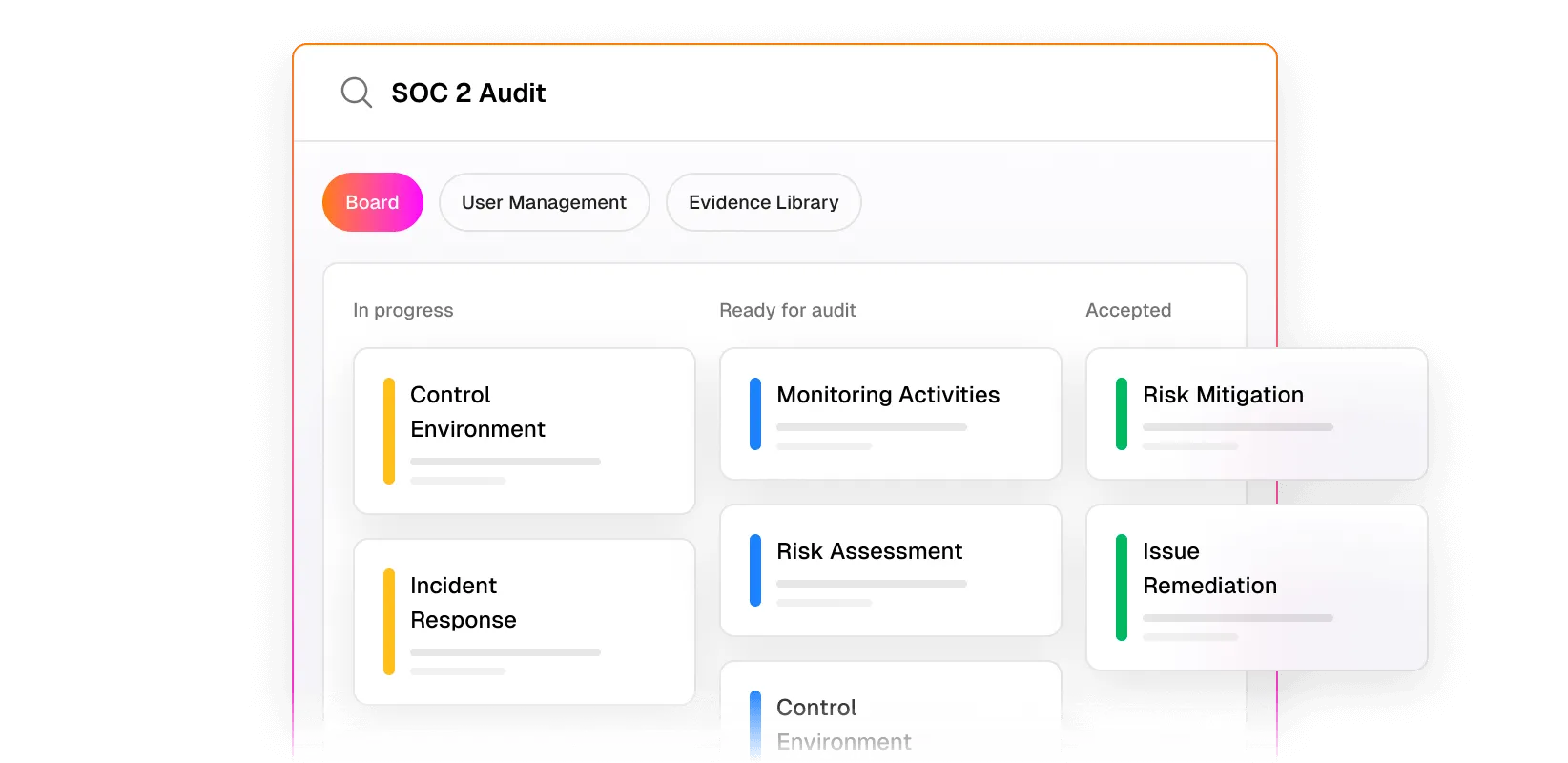
Here is how the economics work:
- Automated evidence collection: Replaces 100-300 hours of manual work per audit cycle. At an average fully-loaded staff cost of $75/hour, that is $7,500 – $22,500 saved per year in evidence gathering alone.
- Pre-built policy templates: Saves 40-80 hours of policy writing. At consultant rates of $200/hour, that is $8,000 – $16,000 in avoided consulting fees.
- Cross-framework control mapping: Companies pursuing both SOC 2 and ISO 27001 avoid duplicated effort by mapping overlapping controls once. This saves 30-40% of total implementation effort for the second framework.
- Continuous monitoring reduces audit time: When auditors find organized, automatically-collected evidence, the audit goes faster and costs less. Companies using automation report 20-30% lower audit fees because auditors spend fewer hours on evidence review.
- Reduced consultant dependency: With platform guidance, templates, and automated workflows, companies can handle 70-80% of compliance work in-house, reserving consultants for strategic decisions only.
Leading compliance automation platforms by price
| Platform | Starting Price | Frameworks Covered | Key Differentiator |
|---|---|---|---|
| Copla | 2,999/year | ISO 27001, SOC 2, DORA, NIS2, PCI DSS | Real CISO support included, 20% off additional frameworks |
| Sprinto | ~$8,000/year | SOC 2, ISO 27001, HIPAA, GDPR | Automation-first, fast time-to-compliance |
| Drata | ~$10,000/year | SOC 2, ISO 27001, HIPAA, PCI DSS, GDPR | 85+ integrations, broad framework coverage |
| Vanta | ~$10,000/year | SOC 2, ISO 27001, HIPAA, PCI DSS, GDPR | Trust center for prospect-facing compliance sharing |
| Secureframe | ~$10,000/year | SOC 2, ISO 27001, HIPAA, PCI DSS | Automated employee onboarding for compliance |
| Hyperproof | Custom pricing | SOC 2, ISO 27001, HIPAA, NIST, FedRAMP | Strong multi-framework compliance management |
For a detailed comparison, explore our compliance software category on Tekpon.
How to budget for compliance: a practical framework
For SaaS companies planning their first compliance initiative, here is a practical budgeting framework based on company size:
Startups (10-50 employees)
Focus on SOC 2 Type II as the first framework – it is what most enterprise buyers ask for. Budget $20,000 – $40,000 total for year one with a compliance automation platform. Timeline: 4-8 weeks to audit-ready with automation.
Growth-stage (50-200 employees)
Pursue SOC 2 + ISO 27001 together to maximize cross-framework savings. Budget $35,000 – $70,000 for year one. Consider a platform that includes expert support (vCISO or fractional CISO) to avoid additional consulting costs. Timeline: 8-16 weeks to dual-framework readiness.
Mid-market (200-1,000 employees)
Multiple frameworks likely required (SOC 2 + ISO 27001 + PCI DSS or HIPAA). Budget $60,000 – $150,000 for year one. At this size, consider whether a dedicated compliance hire ($100,000 – $150,000/year) or fractional CISO services offer better ROI than pure consultant reliance.
Compliance cost FAQ
The external audit fee alone (SOC 2 Type II) runs $15,000 – $60,000. Preparation costs – gap assessment, policy documentation, control implementation, and evidence collection – add another $30,000 – $90,000 manually, or $5,000 – $25,000 with automation. Ongoing annual costs are typically 50-70% of the first-year investment.
Copla’s ISO 27001 plan starts at EUR 2,999/year for the platform, with CISO support included. Annual surveillance audits in years 2 and 3 cost $5,000 – $20,000.
Companies using compliance automation typically see 20-30% lower audit fees because auditors spend less time on evidence review. For more on audit preparation, see our compliance audit guide.
For companies that need both, implementing them together saves 30-40% due to significant control overlap. Most compliance automation platforms support both frameworks with shared controls.
- use compliance automation software to replace manual evidence collection and monitoring (saves 40-60% of staff time)
- start early to avoid premium rush rates from consultants, pursue multiple frameworks together to leverage control overlap
- invest in infrastructure hygiene before starting compliance
- use platform-included policy templates instead of paying consultants to draft them
Companies that combine a platform like Copla, Drata, or Vanta with targeted consulting for strategic decisions achieve the best cost-to-outcome ratio.
A QSA audit runs $15,000 – $75,000, quarterly ASV scans cost $1,000 – $5,000/year, and penetration testing adds $5,000 – $30,000/year. Companies using tokenized payment processors (Stripe, Braintree) have significantly lower scope and cost.
Unlike SOC 2 and ISO 27001, HIPAA has no formal certification, but third-party assessments are increasingly expected by customers and partners.
The cost of getting SOC 2 ($20,000 – $40,000 for a startup using automation) is almost always less than the revenue lost from being unable to close enterprise deals. Start with SOC 2 Type II and add ISO 27001 when expanding into European markets.