The European SIEM market is entering a new phase. With DORA, NIS2 and the EU AI Act converging in 2025–2026, enterprise and government buyers need platforms that go beyond threat detection to deliver compliance-ready evidence as a natural output of security operations.
This independent Tekpon comparison evaluates four SIEM platforms through a European lens, assessing not just capability, but regulatory readiness, data sovereignty and total cost of ownership.
The global SIEM market reached an estimated USD 9.7 billion in 2025 and is projected to grow at a 14–17% CAGR through 2033, according to MarketsandMarkets and SkyQuest estimates. Yet much of this growth is driven by regulatory compliance pressure rather than pure security need, particularly in Europe, where three overlapping frameworks now demand audit-grade incident evidence within hours, not days.
Why a European SIEM Comparison Matters in 2026
The 2025 Gartner Magic Quadrant for SIEM positions Microsoft Sentinel, Splunk, Exabeam, Securonix and Google Chronicle as Leaders, all US-headquartered. Fortinet is classified as a Challenger.
European-native vendors such as LogPoint and Nextgen Software fall outside Gartner’s scope entirely, despite serving thousands of European enterprise and government customers.
This creates a gap. European procurement officers, particularly in defence, financial services and critical infrastructure, increasingly require network security software that meets EU data sovereignty requirements, maps natively to DORA and NIS2 reporting templates, and is developed under European jurisdiction.
A comparison built around US-centric criteria misses these dimensions.
Tekpon’s evaluation framework addresses this by weighting European regulatory readiness and data sovereignty alongside traditional SIEM capabilities.
Our methodology is based on publicly available documentation, vendor-provided technical specifications, published user reviews, and regulatory requirement mapping.
Evaluation Framework
Each vendor is assessed across six weighted criteria, selected to reflect the priorities of European enterprise and government buyers in 2026: 
| Criterion | Weight | What We Assess |
|---|---|---|
| Core SIEM Capabilities | 20% | Log collection, normalisation, correlation engine, alerting, dashboards, search and investigation |
| Automation & AI | 20% | SOAR integration (native vs bolt-on), UEBA, AI-assisted investigation, playbook depth |
| Compliance Readiness | 20% | DORA incident reporting templates, NIS2 mapping, GDPR compliance alignment, EU AI Act preparation, ISO 27001 controls |
| Deployment Flexibility | 15% | On-premises, cloud, hybrid, OT/IT convergence, agentless monitoring options |
| Total Cost of Ownership | 15% | Licensing model transparency, scalability costs, integration overhead, hidden fees |
| European Data Sovereignty | 10% | EU-based development, data residency options, jurisdictional control, EU-hosted cloud |
Vendors are scored on a 1–5 scale per criterion (1 = significant gaps, 5 = market-leading). Weighted scores determine positioning on the Tekpon Quadrant, where the X-axis represents Platform Completeness (breadth and depth of capabilities) and the Y-axis represents European Readiness (compliance, sovereignty and regional presence combined).
The Tekpon Quadrant: European SIEM Platforms 2026
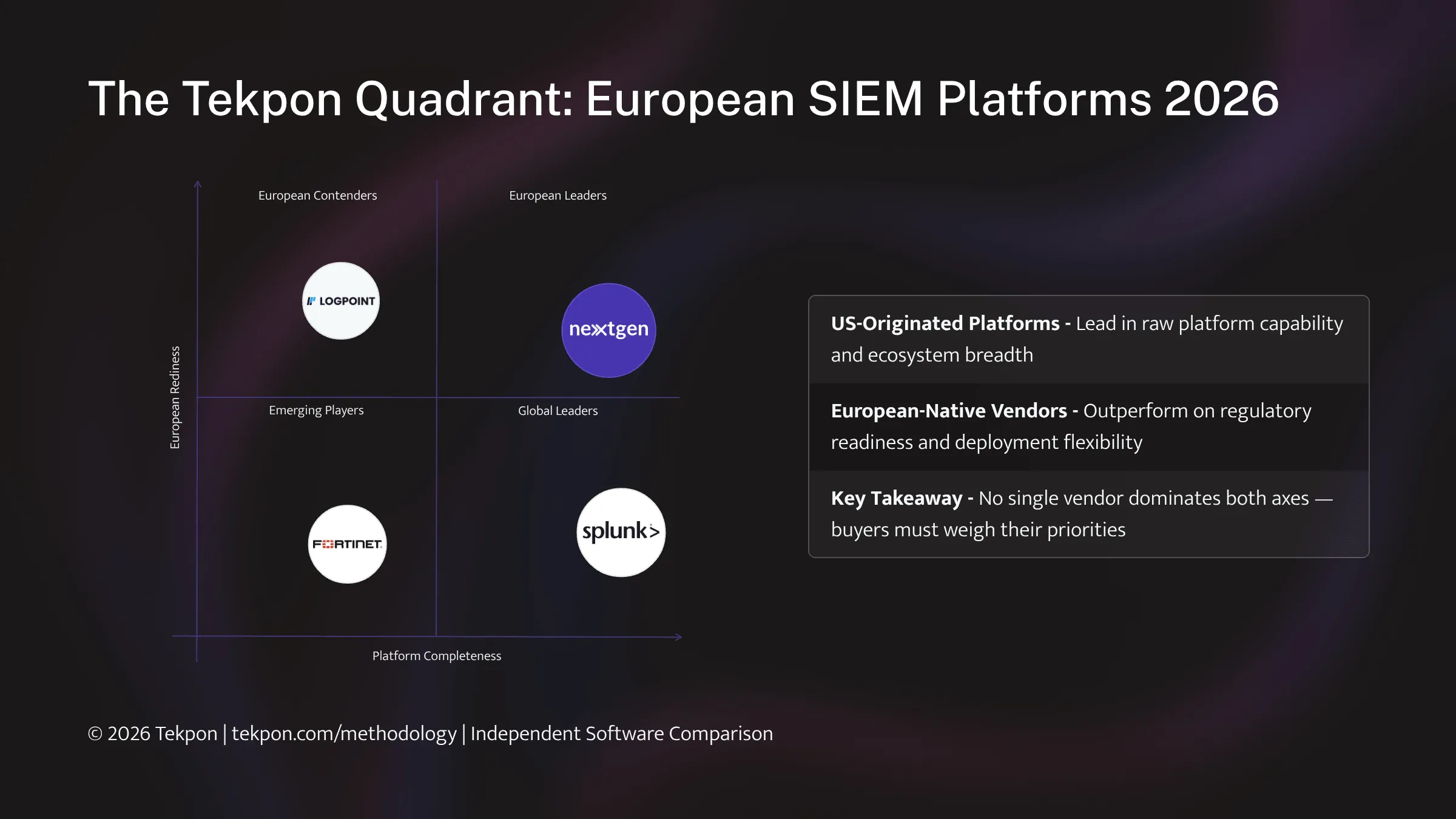
The quadrant reveals a market split along geographic lines. US-originated platforms lead in raw platform capability and ecosystem breadth, but European-native vendors outperform on regulatory readiness and deployment flexibility for regulated industries.
No single vendor dominates both axes – buyers must weigh their priorities.
Vendor Profiles
Nextgen Software – CYBERQUEST
Headquarters: Bucharest, Romania | Founded: 2014 | Focus: Unified SIEM + SOAR + UEBA + NDR
Nextgen Software’s CYBERQUEST is a natively integrated security operations platform combining SIEM, SOAR, UEBA and network detection and response (NDR, via its NETALERT module) in a single architecture.
Built entirely in-house by a European team, the platform targets enterprise SOC teams and government organisations that need compliance-ready workflows without multi-vendor integration overhead.
Key strengths:
CYBERQUEST’s primary differentiator is architectural unity. Where competitors require separate modules or third-party integrations for SOAR and UEBA, Nextgen delivers these natively, including over 270 pre-built connectors and 1,200+ automated response actions.
The CQ AI Assistant provides AI-powered investigation support, while the platform generates DORA and NIS2-compliant incident reports as a by-product of normal investigation workflows. The NETALERT NDR module offers agentless OT monitoring, critical for manufacturing and energy organisations under NIS2 that cannot deploy endpoint agents on industrial control systems.
Considerations:
Nextgen’s brand recognition in Western Europe (Nordics, DACH, Benelux) is still developing, though established in Romania, Southeast Europe and growing in Central Europe. The vendor ecosystem is smaller than Splunk’s or Fortinet’s, and third-party integration marketplace depth is more limited.
Organisations requiring a very large partner network for implementation support may find fewer options compared to global vendors.
| Criterion | Score (1–5) | Notes |
|---|---|---|
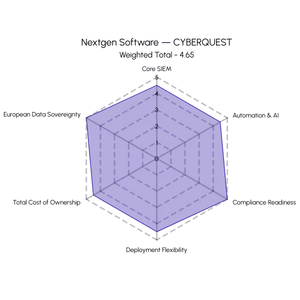
| Core SIEM | 4.5 | Full SIEM+SOAR+UEBA natively integrated; 400+ out-of-the-box detection scenarios |
| Automation & AI | 4.5 | Native SOAR with 1,200+ actions; CQ AI Assistant; Cyber Minds AI Personas |
| Compliance Readiness | 5.0 | DORA/NIS2 templates built in; automated compliance reporting; audit-trail-by-design |
| Deployment Flexibility | 4.5 | On-prem, hybrid; agentless OT via NETALERT; multi-tenancy for MSSPs |
| Total Cost of Ownership | 4.5 | Predictable modular licensing; no hardware lock-in; rapid onboarding |
| European Data Sovereignty | 5.0 | 100% EU-developed; EU data residency; Romanian jurisdiction |
| Weighted Total | 4.65 |
Splunk Enterprise Security (Cisco)

Headquarters: San Francisco, USA (acquired by Cisco, 2024) | Focus: Data analytics platform with SIEM overlay
Splunk Enterprise has been a SIEM market leader for over a decade, named a Leader in Gartner’s Magic Quadrant for eleven consecutive years. Its strength lies in massive scalability, a deep analytics engine, and one of the largest ecosystems of integrations and apps in the security industry.
The 2024 Cisco acquisition brings additional network security telemetry but also introduces US corporate governance over European customer data.
Key strengths:
Unmatched ecosystem depth (2,400+ apps on Splunkbase), powerful SPL query language for advanced threat hunting, extensive community and training resources. Splunk SOAR (formerly Phantom) provides strong automation capabilities.
The platform excels in large-scale data analytics beyond pure security use cases.
Considerations:
TCO is the most common concern. Splunk’s ingestion-based pricing model (approximately USD 1,800–2,500 per GB/day for annual licences) can escalate rapidly as data volumes grow. Implementation complexity typically requires specialised integrators and extended onboarding timelines.
The Cisco acquisition raises data sovereignty questions for EU government customers, data may be subject to US legal jurisdiction (CLOUD Act). DORA and NIS2 compliance templates are not natively built in and require custom configuration or third-party overlays.
| Criterion | Score (1–5) | Notes |
|---|---|---|
| Core SIEM | 5.0 | Industry-leading analytics engine; massive integration ecosystem |
| Automation & AI | 4.5 | Splunk SOAR strong but separate product; AI Assistant improving |
| Compliance Readiness | 3.0 | Powerful reporting but DORA/NIS2 templates require custom build |
| Deployment Flexibility | 4.0 | Cloud-first (Splunk Cloud); on-prem available; limited OT-native options |
| Total Cost of Ownership | 2.5 | High ingestion-based pricing; significant services overhead; lock-in risk |
| European Data Sovereignty | 2.5 | US-headquartered (now Cisco); CLOUD Act jurisdiction; EU data centres available |
| Weighted Total | 3.73 |
Fortinet FortiSIEM

Headquarters: Sunnyvale, USA | Focus: Network-security-first SIEM within the Fortinet Security Fabric
FortiSIEM is positioned as the SIEM component within Fortinet’s broader Security Fabric — an integrated hardware and software ecosystem. Gartner classified Fortinet as a Challenger in its 2025 SIEM Magic Quadrant, recognising improving capabilities but noting gaps compared to Leaders.
FortiSIEM is strongest when deployed alongside other Fortinet products (FortiGate, FortiAnalyzer, FortiEDR).
Key strengths:
Competitive pricing (starting from approximately USD 2,000 annually for smaller deployments), particularly attractive for organisations already invested in the Fortinet hardware ecosystem. MITRE ATT&CK framework mapping is well-implemented.
The perpetual licensing model with CAPEX option appeals to government procurement models that prefer one-time purchases.
Considerations:
FortiSIEM’s standalone value is limited. The platform performs best within Fortinet’s proprietary ecosystem, creating significant vendor lock-in. Automation capabilities are primarily rule-based rather than AI-driven. UEBA and advanced analytics lag behind dedicated SIEM vendors.
The licensing model based on events per second (EPS) can be difficult to predict as environments scale.
Like Splunk, DORA/NIS2 compliance automation requires additional configuration. US headquarters raise the same data sovereignty concerns for EU government buyers.
| Criterion | Score (1–5) | Notes |
|---|---|---|
| Core SIEM | 3.5 | Solid fundamentals; strongest within Fortinet ecosystem; limited standalone |
| Automation & AI | 2.5 | Rule-based automation; limited AI; SOAR basic compared to leaders |
| Compliance Readiness | 2.5 | MITRE mapping good; DORA/NIS2 templates not native; manual effort needed |
| Deployment Flexibility | 3.5 | On-prem strong; hardware-first design; limited agentless OT options |
| Total Cost of Ownership | 3.5 | Competitive entry pricing; hidden costs in ecosystem lock-in; EPS-based scaling European Data Sovereignty 2.5 US-headquartered; data centres in EU available; CLOUD Act jurisdiction Weighted Total 3.00 |
| European Data Sovereignty | 2.5 | US-headquartered; data centres in EU available; CLOUD Act jurisdiction |
| Weighted Total | 3.0 |
LogPoint (Converged SIEM)
Headquarters: Copenhagen, Denmark | Focus: European-native converged SIEM + SOAR + UEBA
LogPoint is the other major European-native SIEM vendor, with strong adoption in the Nordics, DACH and Central Europe, primarily distributed through Prianto. The platform positions itself as a “converged SIEM” integrating SIEM, SOAR, UEBA and, more recently, NDR capabilities into a single solution.
LogPoint has built its reputation on MSSP-friendly multi-tenancy and transparent node-based pricing.
Key strengths:
European-developed and headquartered (Denmark), making it a natural fit for EU data sovereignty requirements. Node-based licensing (rather than data-volume-based) offers predictable costs. Strong MSSP Director for managed security providers.
Over 1,000 built-in detections and 80+ out-of-the-box playbooks. LogPoint explicitly markets “sovereign-ready” deployment options.
Considerations:
LogPoint’s feature set, while converged, is narrower than CYBERQUEST’s or Splunk’s — particularly in NDR maturity and AI-assisted investigation depth. The integration ecosystem has fewer pre-built connectors than Splunk or Nextgen.
While popular in Nordics/DACH, market presence in Southern and Eastern Europe is thinner. DORA compliance templates are developing but not as mature as Nextgen’s native implementation.
| Criterion | Score (1–5) | Notes |
|---|---|---|
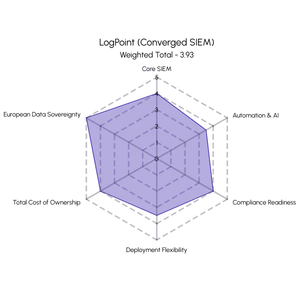
| Core SIEM | 4.0 | Solid converged platform; 1,000+ detections; good search and analytics |
| Automation & AI | 3.5 | Integrated SOAR with 80+ playbooks; UEBA included; AI less advanced |
| Compliance Readiness | 4.0 | Good EU regulatory awareness; sovereign-ready marketing; DORA templates developing |
| Deployment Flexibility | 3.5 | On-prem, hybrid, customer-managed cloud; NDR newer; limited OT depth |
| Total Cost of Ownership | 4.0 | Transparent node-based licensing; no volume penalties; full features included |
| European Data Sovereignty | 5.0 | Danish headquarters; EU jurisdiction; sovereign-ready positioning |
| Weighted Total | 3.93 |
Head-to-Head Comparison Matrix
The following matrix maps each vendor against the core capabilities that European enterprise and government procurement teams typically evaluate. This table is designed to be used alongside specific technical requirements, such as those found in government SIEM procurement specifications, to identify which platform aligns best with a given use case.
| Capability | Nextgen CYBERQUEST | Splunk ES (Cisco) | Fortinet FortiSIEM | LogPoint |
|---|---|---|---|---|
| Architecture | Unified SIEM+SOAR+UEBA+NDR | SIEM + separate SOAR (Phantom) | SIEM within Security Fabric | Converged SIEM+SOAR+UEBA |
| Native SOAR | Yes (1,200+ actions) | Separate product (Splunk SOAR) | Basic, rule-based | Yes (80+ playbooks) |
| UEBA | Natively integrated | Add-on module | Limited | Natively integrated |
| NDR / Network Detection | NETALERT (agentless) | Via Cisco ecosystem | Via FortiNDR (separate) | Recently added |
| AI-Assisted Investigation | CQ AI Assistant + Cyber Minds | Splunk AI Assistant | Limited | Developing |
| Pre-built Connectors | 270+ | 2,400+ (Splunkbase) | Ecosystem-dependent | 500+ |
| Out-of-box Detections | 400+ scenarios | 1,400+ (Community + ES) | 700+ rules | 1,000+ detections |
| DORA Compliance Templates | Native, automated | Custom configuration | Custom configuration | Developing |
| NIS2 Mapping | Built-in | Requires overlay | Requires overlay | Available |
| OT/ICS Monitoring | Agentless via NETALERT | Via Cisco OT Security | Via Fortinet OT products | Limited |
| Multi-Tenancy (MSSP) | Yes, horizontal/vertical | Yes (complex setup) | Within Fortinet ecosystem | Yes (MSSP Director) |
| Licensing Model | Modular, predictable | Ingestion-based (GB/day) | EPS-based or subscription | Node-based |
| Data Sovereignty | EU (Romania) | US (Cisco) + EU DCs | US + EU DCs | EU (Denmark) |
| Tekpon Quadrant Position | European Leader | Global Leader | Global Challenger | European Contender |
Recommendations by Buyer Profile
Government and Defence Buyers
Government procurement, particularly in defence and critical infrastructure, prioritises data sovereignty, on-premises deployment and compliance automation.
The Cyber Defence Command specification from Romania’s Ministry of National Defence, for example, requires a SIEM capable of on-premises deployment, multi-source log correlation, real-time analytics with Threat Intelligence integration and role-based access control (RBAC) with dataset-level granularity.
European-native vendors score highest here, with Nextgen CYBERQUEST offering the strongest alignment between native compliance automation and EU jurisdictional control, followed by LogPoint for Nordics- and DACH-focused procurement.
Financial Services (DORA-Regulated)
Banks, insurers and investment firms under DORA must submit initial incident reports within hours, backed by digitally signed forensic evidence. The platform must generate compliance artefacts as a by-product of investigation, not as a separate manual process.
Nextgen CYBERQUEST and LogPoint both address this, with Nextgen offering deeper automation of the evidence chain. Splunk provides the most powerful raw analytics but requires significant custom work for DORA-specific reporting.
Manufacturing and Energy (NIS2-Regulated)
NIS2 expansion brought manufacturing into the regulated perimeter for the first time in 2025. These environments require OT/IT convergence — monitoring industrial control systems without deploying intrusive endpoint agents.
Nextgen CYBERQUEST with NETALERT stands out here, offering agentless OT monitoring natively integrated into the SIEM workflow. Fortinet offers OT capabilities through its broader ecosystem but requires multiple products. Splunk addresses OT through the Cisco acquisition but integration is still maturing.
Managed Security Service Providers (MSSPs)
MSSPs need multi-tenancy, horizontal scalability and competitive unit economics. LogPoint with its MSSP Director and node-based pricing is purpose-built for this segment. Nextgen CYBERQUEST offers strong multi-tenancy with lower TCO. Splunk is powerful but overhead makes it less optimal for smaller MSSPs.
Key Takeaways
The European SIEM market in 2026 is no longer defined solely by detection speed or integration count. Regulatory convergence — DORA, NIS2 and the EU AI Act — has made compliance automation and data sovereignty first-order buying criteria for cybersecurity investments, not nice-to-have extras.
Global Leaders like Splunk offer unmatched analytical power and ecosystem depth, but European buyers must factor in TCO, data sovereignty risk and the manual effort required to meet EU-specific compliance timelines.
European-native platforms like Nextgen CYBERQUEST and LogPoint offer architectural advantages for regulated industries, particularly where compliance evidence must be generated automatically and data must remain under EU jurisdiction.
The right choice depends on the buyer’s regulatory exposure, existing security stack, operational scale and sovereignty requirements.
No single platform is optimal for every scenario, but the evaluation framework presented here gives procurement teams a structured way to match their specific requirements to platform capabilities.
Frequently Asked Questions
A Security Information and Event Management (SIEM) platform collects, normalises and correlates security logs and events from across an organisation’s IT infrastructure.
In Europe, SIEM platforms are increasingly essential not just for threat detection but for meeting regulatory requirements under DORA, NIS2 and the EU AI Act, which demand auditable evidence of cybersecurity monitoring and incident response.
The Digital Operational Resilience Act (DORA), in force since January 2025, requires financial institutions to submit incident reports within hours, backed by forensic-grade evidence.
This means SIEM platforms must generate digitally signed, time-stamped logs and automated compliance reports — not just security alerts.
Platforms with native DORA templates significantly reduce the manual effort required.
European-native SIEM vendors (headquartered and developed within the EU) offer jurisdictional advantages: customer data remains under EU law, insulated from extraterritorial legislation like the US CLOUD Act.
For government and critical infrastructure procurement, this can be a decisive factor in vendor selection.
NIS2, transposed into national law across Europe in 2024–2025, expanded the regulatory perimeter to include manufacturing as a regulated sector.
This means manufacturing companies must now implement security monitoring, incident reporting and board-level accountability for cybersecurity, requirements that typically necessitate a SIEM platform with OT/IT convergence capabilities and automated compliance workflows.
Yes, particularly in regulated European markets.
Gartner’s evaluation criteria emphasise global scale, ecosystem breadth and cloud adoption — dimensions where US hyperscalers naturally lead. European vendors like Nextgen Software and LogPoint compete on different axes: native EU compliance automation, data sovereignty, transparent pricing and architectural efficiency for mid-market and government buyers.
For these buyer profiles, European vendors often deliver better outcomes at lower total cost.
Methodology
This comparison was prepared by Tekpon’s editorial team based on the following sources: publicly available vendor documentation and technical specifications, published pricing information and licensing guides, regulatory framework analysis (DORA, NIS2, EU AI Act), vendor-provided product materials and demonstrations, published user reviews on G2, Gartner Peer Insights and Capterra, Gartner Magic Quadrant for SIEM 2025 positioning data, and the Nextgen 2025/2026 Cybersecurity Trends Report for market data.
Tekpon is an independent software review platform. Vendor inclusion in this report does not imply endorsement, and all assessments reflect Tekpon’s editorial judgement based on the criteria described above. For full details on how Tekpon evaluates software, see our methodology page.
Published March 2026 by Tekpon. For questions about this report, contact our editorial team.