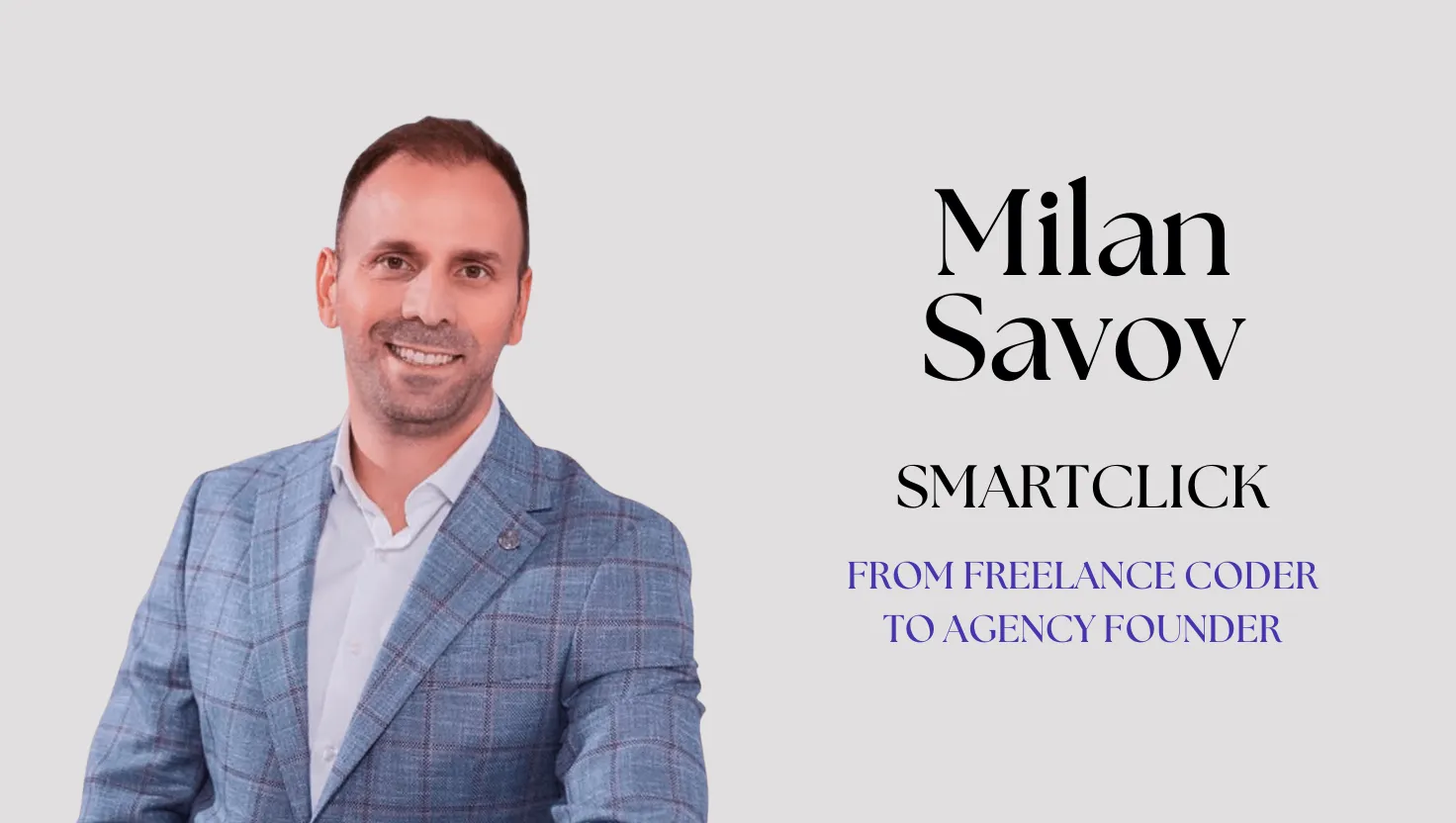
Milan Savov began as a solo coder tackling projects around the world. Over time, he refined his craft and vision, founding SmartClick to help businesses grow through strategic SEO and web development. In this interview, he reflects on the transitions, challenges, and decisions that shaped his path from freelancer to agency leader on the global stage.
“From solo to B2B SaaS”
“When you’re alone at 2 a.m. finishing a site for a UK client, you don’t yet see the limits of being solo.“
Maria Stanciuc: What was the moment when you realised that generative AI would change everything for search and discovery?
Milan Savov: There were two very clear moments.
The first one was personal. As a freelancer, I was part of teams in the U.S., the UK, Australia… but I was alone. I had no one next to me who could challenge my thinking, solve problems with me, or share the pressure.
I didn’t want to stay “the solo guy behind a laptop.” I wanted to build a team around me, people I trust, people who can execute together, not just jump from project to project on my own at 2 AM.
The second moment was strategic. I was building beautiful, functional websites. Clients loved them. But at some point, I asked myself a very direct question: why are these companies actually paying for a website? And the real answer is not “design.” The real answer is revenue. Pipeline. Qualified leads.
That’s when I stopped thinking like a freelancer and started thinking like a company. It’s also when I partnered with Branko. I had the product, the build, the delivery. He brought the acquisition and demand side – how we attract the right traffic, how we turn that into leads, and how we impact revenue. That combination is basically the seed of SmartClick.
Maria Stanciuc: From Strumica to clients in Australia, the UK, and the US. How did working across such diverse geographies shape your leadership or worldview?
Milan Savov: Working with clients around the world was a huge challenge at first, because it was all new. I’m coming from a small country, and I was suddenly working with people in markets that are much more developed. My first mindset was: “They’re better than me.”
Then I actually started working with their teams, and I saw there is no difference in capability. The only difference is confidence and access.
That gave me a lot of belief. I was delivering high-quality work, building strong relationships, and they started trusting me with more and more responsibility, not just coding, but coordinating, leading projects, and communicating with their internal stakeholders. At one point, I was the developer, the PM, and the account lead at the same time. I also reached the point where I had to start hiring people around me just to keep up with the volume.
That period gave me two things: a global portfolio and long-term relationships that still help us today as a company.
And it shaped how I lead today: I expect my team in North Macedonia to deliver at a global standard, and I never let anyone internally play small just because of geography. The market doesn’t care where you’re based. The market cares if you solve a real problem.
Maria: SmartClick began with a focus on web development and evolved into a fully integrated web + seo agency for b2b saas. What pushed you to specialise and double down on that niche?
Milan: When I initially started SmartClick, I basically took my own skill set, WordPress development, and turned it into an “agency service.” In the beginning, it was just me, and then one more developer. Most projects came from platforms like Upwork and Toptal. We worked with startups, mid-size companies, and even enterprises across a lot of different industries and countries.
That’s fine in the beginning because you’re collecting experience. But once you want to be positioned as an expert, you can’t do everything for everyone. You need to choose.
First, I tried e-commerce as a niche because I had some interesting clients there. It wasn’t the right fit. I tried another direction. Still not it. The third attempt was B2B SaaS, and that’s where everything clicked.
Once we leaned into this space, we went all in. We started showing up at the right events, joining the right communities, and deeply studying their challenges and their buying reality. Now we literally breathe with these companies. We’re positioning ourselves as their organic growth partner, not a vendor.
Two reasons.
First: B2B SaaS cares about pipeline, not just “a nice website.” When we owned both the website and the organic acquisition engine behind it, positioning, demand capture, and SEO, we stopped being seen as “the team that builds pages.”
We became growth partners. That’s when we knew this is our lane.Second: I feel close to these people. A lot of SaaS founders come from technical backgrounds. They’re open-minded, they invest in growth, they’re willing to share their learnings and get honest about what’s blocking revenue.
I want to work with people like that, people who also make me better as a business owner.“Achievement, learning and growth, integrity, and quality”
Maria: Reflecting on your early freelance years, what habit or mindset from that period still serves you as ceo today?
Milan: From a mindset perspective, it’s definitely “do the extra mile.”
As a freelancer, I always tried to deliver more than what we agreed on. Not just working late, but caring about the tiny details that make something actually usable. Clients felt that. They appreciated it. I was getting bigger bonuses and, more importantly, more ownership.
From a habit perspective, I’ve always been very intentional with planning. Even back then, alone, I would plan my work at least a week in advance, focus on the highest-value tasks, and not get lost in noise. I still do that now – just at a company level.
My job today is to make sure the team is spending time on what actually moves the business and the client forward, not just filling hours.
Maria: How do you keep those alive as the team expands and complexity increases?
Values are non-negotiable for me. We hire based on them, and we operate based on them. We communicate them from the very first interview, so people know what we’re building and what standard they’re walking into.
Achievement: We want to achieve real outcomes, for the client, for the company, for ourselves. We’re not here just to “do tasks.”
Learning and growth: There’s a quote I like: “You either grow, or you die”. There’s nothing in the middle. If we don’t adapt to new tech, new trends, and new buyer behavior, we’re out of the game fast, especially now in the AI era.
Integrity: If we promise something, we deliver it. If we don’t know something, we say it early. If there’s a blind spot, whether it’s internal or with a client, it has to be surfaced. Communication is not “nice to have” for us; it’s part of how we protect the relationship.
Quality: For us, quality is not “does this look nice.” Quality is “Does this asset help generate revenue?”
And I’ll be very direct: we’re not scared to move fast when values don’t match. Skills we can train. Misalignment on integrity is toxic.
Maria: In the agency world where speed and change are constant, how do you decide when to pivot vs when to persist, especially in markets like SEO or web development?
Milan: Both “pivot too fast” and “persist too long” can kill you. The rule I use is this: Are we failing because the strategy is wrong, or because the execution hasn’t had enough time to compound yet?
Example: SEO in B2B SaaS.If the ICP is clear, the search intent is validated, the offer matches the pain, and we’re building real topical depth, that’s a compounding play. You don’t pivot out of that after six weeks. You double down, and you protect it from panic.
But if we’re producing content that will never convert because the ICP is misaligned? Then, persisting is just ego.
On the web side, it’s almost the opposite. If the messaging on the site isn’t landing, and win rates aren’t improving after a redesign, you don’t wait six months to “collect more data.” You get Sales in the room this week, and you rewrite the narrative.
So I’ll put it like this:
- In channels that have compounding payoff (SEO), I persist.
- In assets that should produce fast signals (landing pages, demos, messaging), I pivot fast.
And you need discipline. There are a lot of shiny objects, and as business owners, we get distracted easily. Consistency in a boring but working channel beats “reinvention” every quarter.
Maria: Can you share a story about a client or project where everything went wrong initially, and how that turned into a breakthrough for you or your team?
Milan: A few months ago, we had a new client who got hit by a Google algorithm update. His site saw a big traffic drop because of technical issues, and he basically said, “I need help now.”
Our team dropped everything and worked through the weekend to recover the situation. We stabilised it. Then later, he got hit again with another drop, and because we showed up for him in that first crisis, he decided to trust us long-term and let us handle the recovery again. Today we’re still working together on multiple projects.
That weekend built more trust than three months of normal delivery. That trust is the difference between being treated as “an agency” and being treated like part of the company.
Second story. We signed a client and started our initial analysis phase. We went into deep work mode, didn’t bother them, and planned to come back with a big polished presentation.
From our side, that was us being professional.
From their side, it looked like: “I paid you, and you disappeared. Are you actually doing anything?” That feedback changed how we operate. Now, every client gets a weekly report: what we did last week, what’s happening next week, and top priorities. We make sure they never feel like nothing is happening.
To sum it up: we thought silence was “focus.” The client read silence as “did they run with my money?” We fixed that permanently.
Maria: Outside of business: what do you do to recharge, stay curious, or step away from screens?
I use every spare moment I can to travel and spend time with my family. Time with my kids forces me to switch contexts. It reminds me why I’m building this, not for status, but for freedom. I also take time alone when I can. I go for a walk, or I just step away and reflect. You can’t see structural problems when you’re in “execution mode” all day.
To stay curious, I’m constantly learning. I read a lot about business, sales, marketing, and psychology. I invest in communication and sales training. I’m part of a few mastermind groups. I like being around people who are actually building, not just talking.
That keeps me sharp.
“We can create global success from Macedonia.”
Maria: Looking ahead: the world of websites, SEO, and discovery is changing fast with AI and new platforms. What excites you most, and what keeps you up at night?
Milan: The real shift is this: buyers won’t just “Google and compare websites” anymore. They’ll ask AI directly, “Who should I talk to for X?” And if you’re not in that short list of recommended answers, you’re invisible.
That completely changes how we build. Clarity of positioning, proof, and credibility signals becomes critical. You can’t afford to sound generic. You have to be very explicit: who you serve, what pain you solve, why you’re the safest choice. That’s where we’re focusing.
AI is exciting because it speeds up a lot: building pages, testing ideas, and creating first drafts of content. You can move faster than before. Early-stage companies, especially, can use that speed to experiment.
But there’s a problem. A lot of people now believe AI can do everything, instantly, at full quality. So they expect “cheap and fast,” and they think that’s the same thing as “effective.” It’s not. You still need a strategy. You still need someone who understands demand, positioning, and value creation.
What keeps me up at night is that expertise is getting underestimated. Too many people think distribution and messaging can just be automated. We’re very clear about this: we’re not trying to work with companies that only want “cheap and quick.” We want the ones who understand that organic growth is an asset.
Maria: As a co-founder, you’ve likely built culture from scratch. If you had to pick one “culture ritual” at SmartClick, something unexpected or unique, what would it be?
Milan: Radical feedback. Anyone in the company can give feedback to anyone, including seniors, if they see a blind spot that’s hurting the work.
That takes courage, but it comes from a place of respect. If you’re willing to tell me where I’m off, you’re trying to make me better, not tear me down. And we’re very clear on the rule: we attack the problem, not the person. That’s important. You’re allowed to say “this is not good enough,” even to a senior, as long as it’s about the work, not about ego.
That level of honesty only works if you have integrity and trust. But once you build it, it keeps you fast, and it keeps you sharp.
Maria: What is the mantra that drives you every day?
Milan: My mantra is: “We can create global success from Macedonia.” You don’t have to be in London or New York to build something elite, and you don’t have to hire in London or New York to get elite work.
That’s the standard I hold internally and the promise I make externally.
Maria: For ambitious developers or agency founders reading this now, what is one piece of advice you wish someone had given you before you started SmartClick?
Most developers hide in “building.” They tell themselves they’re improving the product, but really they’re avoiding rejection.
Sell first.
If nobody wants it, that’s the feedback. If people do want it, you’ll fix the imperfections along the way — with real money, not theory. Decide early if you’re building a job or building a company. Both are fine. But don’t lie to yourself about which game you’re playing. And once you choose, go all in.