The playbook is broken. For decades, tech companies built their go-to-market strategies around product differentiation: features, speed, and competitive matrices. But in the AI era, where every product demo includes “AI-powered” and feature parity arrives in weeks instead of years, that playbook is failing spectacularly.
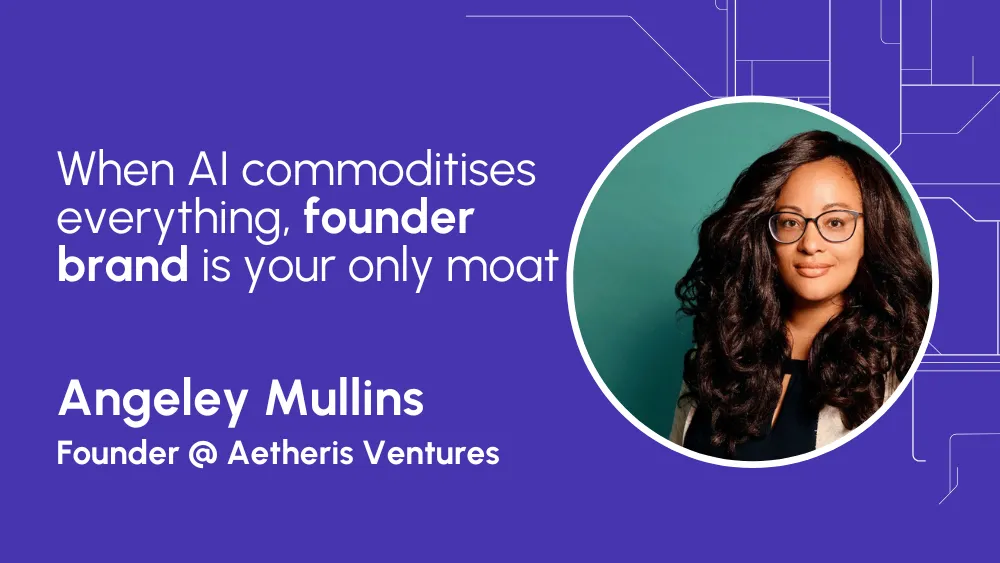
The companies winning today aren’t winning on features. They’re winning on founder brands.
The great AI commoditisation
AI hasn’t just leveled the playing field; it’s absolutely demolished it. What used to take a team of engineers six months to build can now be prototyped in days. Your competitor’s “revolutionary AI feature” announced on Monday will be replicated by three other companies by Friday.
LLMs are being integrated everywhere, and honestly, most of them work pretty well.
When everyone has access to the same foundational models, the same cloud infrastructure, and the same ability to ship fast, product features become table stakes almost immediately. The half-life of technical differentiation has collapsed from years to months, sometimes weeks.
Your beautifully crafted product marketing sales deck highlighting your “proprietary AI algorithms” means nothing when buyers know those algorithms are probably “fine-tuned” versions of the same models everyone else is using.
The reason is structural. When OpenAI, Anthropic, Google, and Meta are racing to release increasingly capable foundation models, and when those models are available via API for pennies on the dollar, the traditional moats of proprietary technology erode almost instantly.
What used to require years of PhD-level research and millions in computing costs can now be achieved in weeks with clever prompting.
The authenticity premium
There is another dynamic at play: authenticity has become the scarcest resource in tech marketing. Every company’s website says the same things. Every demo video has the same aesthetic. Every pitch deck uses the same slide templates.
However, Founders can cut through this noise because they are inherently differentiated. Your story, your vision, your perspective on where the industry is heading can’t be commoditised or replicated by AI.
When Jensen Huang takes the stage in his leather jacket, when Sam Altman tweets about AGI timelines, and when you share your unfiltered take on the industry: that’s signaling in a world drowning in noise.
Buyers are exhausted by perfectly polished corporate messaging. They are craving real humans with real convictions. They want to know what keeps you up at night, what you learned from your last failure, and why you are building what you are building beyond “market opportunity.”
The distribution advantage
Founder-led brands also solve a critical distribution problem. In the AI era, where new products and features launch daily, and attention is fragmenting across platforms, organic reach through founders is often more valuable than paid marketing channels.
The traditional playbook is failing. CPCs on Google Ads have climbed to levels that make customer acquisition economics brutal for early-stage companies. LinkedIn advertising costs continue to rise while performance plateaus.
Every company publishes thought leadership. Every competitor has whitepapers and case studies. AI tools have made it easier to produce more content, flooding the market and giving buyers the paradox of choice.
Buyers are completely overwhelmed.
They have tuned out banner ads. They scroll past sponsored posts. They delete marketing emails without opening them. The channels you are pouring budget into are delivering diminishing returns quarter after quarter ( and higher advertising costs).
Meanwhile, a different distribution channel has emerged as one of the highest-leverage assets a company can build: the founder’s personal platform.
A single thoughtful post from a founder with a cultivated audience can drive more qualified leads than a six-figure ad campaign. A founder’s appearance on the right podcast reaches decision makers during their commute in a way that banner ads never will.
An authentic LinkedIn post about lessons learned resonates more than any case study ever could.
What this means for your go-to-market (GTM) motion
This isn’t an argument to abandon product marketing or traditional advertising because you still need clear positioning, compelling messaging, and well-executed campaigns. However, the balance has shifted dramatically.
Founders and CEOs should spend as much time on brand building as on product development. That means:
- Consistent public presence: Regular writing, speaking, and engaging on platforms where your buyers congregate. Not promotional content but actual perspective and thought leadership.
- Narrative clarity: A compelling point of view about where the industry is heading and why your approach matters. This is not just your mission statement; this is your thesis about the future.
- Transparency and accessibility: Sharing the journey, including the challenges. Founders who humanise the building process create deeper connections than those who only showcase victories.
- Personal credibility building: Your technical expertise, your industry experience, your unique insights should be front and center, not hidden behind corporate messaging.
Why Founders…Why Now
There is a reason why the most successful AI companies of the past two years are virtually inseparable from their founders’ personal brands.
When Kareem Amin shares Clay’s journey, breaking down their growth strategies and sales workflows in real time, he’s not just marketing a product; he’s teaching the market how to think about data enrichment differently.
When Anton Osika and the Lovable team livestream building AI-generated applications and engage developers about the future of coding, they build trust that no polished demo video could create.
When Victor Riparbelli positions Synthesia as a platform for democratising video creation and openly discusses the challenges of synthetic media, he’s doing something product marketing fundamentally cannot: offering his personal credibility as collateral for the company’s promises about responsible AI use.
This matters more than ever because authenticity has become the scarcest resource in tech. Every company’s website uses the same design templates. Every product video has the same aesthetic. Every pitch deck follows the same structure.
The corporate voice of the “carefully focus-grouped, legally reviewed, and optimised for no one to object to” narrative may have become wallpaper.
Founders cut through this because they can’t be replicated. Your story is yours. Your perspective on where AI is heading is uniquely informed by your experiences. Your willingness to take controversial positions, to admit uncertainty, and to share what you’re learning in real time creates connections in ways that corporate communications never can.
When AI can generate infinite amounts of ads and content, the human voice matters more, not less. Buyers are not looking for more information… they are drowning in it. Buyers are looking for judgment, for curation, and for someone they trust to help them navigate complexity. That’s what founder brands provide.
How do you begin?
Start now.
You don’t need a polished content strategy. You need authentic engagement. Share what you’re learning. Take positions on where the industry is heading. Engage in debates. Build relationships. Show your work.
The companies that will win in the AI era won’t be the ones with the best features six months from now. They’ll be the ones whose founders built the most trust, and those relationships are built on founder brands that stand for something, mean something, and matter to the people they are trying to reach.
By 2030, we will be in a world where products are increasingly commoditised, and therefore, people will become the ultimate moat. The most powerful people-based moat is a founder brand that stands for something, means something, and matters to the people you’re trying to reach.
The question isn’t whether you should invest in founder-led branding. The question is whether you can afford not to.